Designing Cubes via Whack-a-mole
Recently Richard Garfield on Lucky Paper’s podcast said something surprising and interesting. “one of my pet peeves [in Modern game design] …is overdevelopment of games.”
We play games because they are fun and interesting. But Garfield seems to be pointing out a trend where game designers take out the powerful cards and combos that makes the game fun for the sake of ‘balance.’ Because to have fun, players need to face some resistance, and Magic creates resistance through two main avenues: opponent’s skill and game variance. While designers can’t control their players’ skill, they do have control over the amount and types of variance that their players are subject to.
Well, what does this have to do with development? While players are shuffling their cards, cube designers that do the curating or ‘balancing’ of the game are making decisions about the text of the individual cards, which cards are acceptable, and which are cut.
Card games uniquely use the randomness in shuffling cards to introduce variance. Whether its bridge, poker, Magic, or Slay the Spire, the randomness and variance in a shuffled library— or a shuffled cube— is a fundamental component of the game. Mark Rosewater has got a lot of literature on how randomness contributes to fun.
To summarize some of his main points, variance is crucial to Magic’s success because,
- Surprise is fun – Each game is different and you don’t know what’s going to happen next.
- It gives players hope – Variance allows all players to have the opportunity to beat higher skilled players.
- Beating variance is itself skill-testing and fun.
While shuffling is a fundamental aspect of a card game meant to introduce variance, some players get overwhelmingly powerful cards relative to the rest of the card pool, and cube designers think that their curation is at fault.
“Oh yeah that card should definitely get cut.”
The popular idea of balance, for better or worse, leads to “variance whack-a-mole,” where designers judge whether individual cards as well as cube archetypes are acceptable to expose to their drafters.
Part 1 of this article series tackles how variance has been scapegoated and how designing cubes via Whack-A-Mole might lead us astray from why we balance our cubes at all.
Part 2 will examine what variance and varied gameplay looks like for power max environments and how I apply this idea to my own cube, Jeepers Creepers.
Part 3 will tackle what the varied nature of cCube gameplay means for best practices moving forward.
Where Anything Goes
Extrapolating from Garfield’s statement, I think the hallmark of when my cube became overdeveloped is when I opened a pack and said, “Well, I guess I can pick literally anything.”
Overtime I had cut cards that I had deemed too powerful, too swingy, too feast or famine so nothing stood head and shoulders above the rest.
For clarity, Ryan Overturf explains a similar problem he had experienced when designing his Spooky Cube.
Full ARTICLE: SPIKEVILLE TO FLAVORTOWN
Naturally with time and experience, Spikes produce specific knowledge about the format that helps ward off decision paralysis. But in a first draft, before players can rely on format knowledge to guide them through a pack, players find ways to determine what’s good, often on merits of power.
So though the Spikes in his community were comfortable navigating the draft with a narrow powerband, Overturf notes the absence of ‘power outliers’ like Psychic Frog or Snapcaster Mage as an accessibility issue.
So while narrow power bands might create a higher barrier to entry, but more importantly, narrow power bands cause cube designers to inadvertently undercut one of the greatest strengths of the cube experience — creating fun by embracing variance. I think many designers end up playing “variance whack-a-mole” even when their cube goals don’t require them to.
This first part of the series applies to cubes with the following goals:
- Want to encourage synergy and buildarounds
- Explicitly lower stakes and are meant for playgroups with less enfranchised players
- Are not designed around playing with Magic’s best cards i.e. power maxed
I suggest that this subsection of cubes should consider a wider power band. Cubes in this realm might include various rarity-restricted cubes, set cubes, and the cubes that have evolved and been redesigned from these two starting places.
Set cubes embrace wider power bands naturally. By using the design skeleton that Wizards has refined over decades, it’s much easier for set cubes to mimic the variance that retail draft formats naturally embrace. If players can enjoy playing with powerful rares in beloved retail limited formats Neon Dynasty or March of Machines, so too can cube formats designed for and by Spikes.
Rarity restricted cubes similarly get to play with amazing cards like Reanimate and Swords to Plowshares at its upper band of power. My Peasant cube on the other hand from years ago, had been stripped of its power outliers and really struggled to push me into fun and uncomfortable situations. Blinking Mulldrifter is fun enough, but it didn’t really capture the spirit of playing with new cards at Prerelease where card evaluations are in flux and powerful rares sometimes get to shine in a big way.
Spikes play Magic in part to prove their worth in a battle of skill and wit. Variance and randomness also fulfills the role of psychological cover, allowing players to blame variance rather than to look inward at how they played out their match. And to be blunt, I think sometimes players are too quick to suggest ideas to help balance the cube of the night, when in reality, the variance they perceive would be more appropriately managed by player skill (in other words ‘skill diff’).
More Power, More Entropy.
Cube is a format where we curate a box of cards. Then we shuffle the cards into packs, before players draft them into decks, and arrange their decklist for a photo. They shuffle their library again before they draw seven, mulligan, and finally play out their hands with their lands separate from their spells. Order then entropy then order then entropy then order.
On the other hand, in Constructed, you can see that 4-ofs and formats with giant card pools allow players to have a lot of control over variance. You can expect every edge to be exploited when prizes are on the line. Cubers hardly get the same kind of reps that a constructed player would be able to find.
If you’re a lover of cube, you can see how variance allows for cube as a format to stay fun and replayable so I think there’s more room to push how much variance we allow for. To explain what I mean, I want to take a look at Anthony Mattox’s Regular Cube because Lucky Papers’ cubes are familiar to many. Though I’ve never drafted the Regular Cube in person so take this thought experiment with a grain of salt.
![][image1]
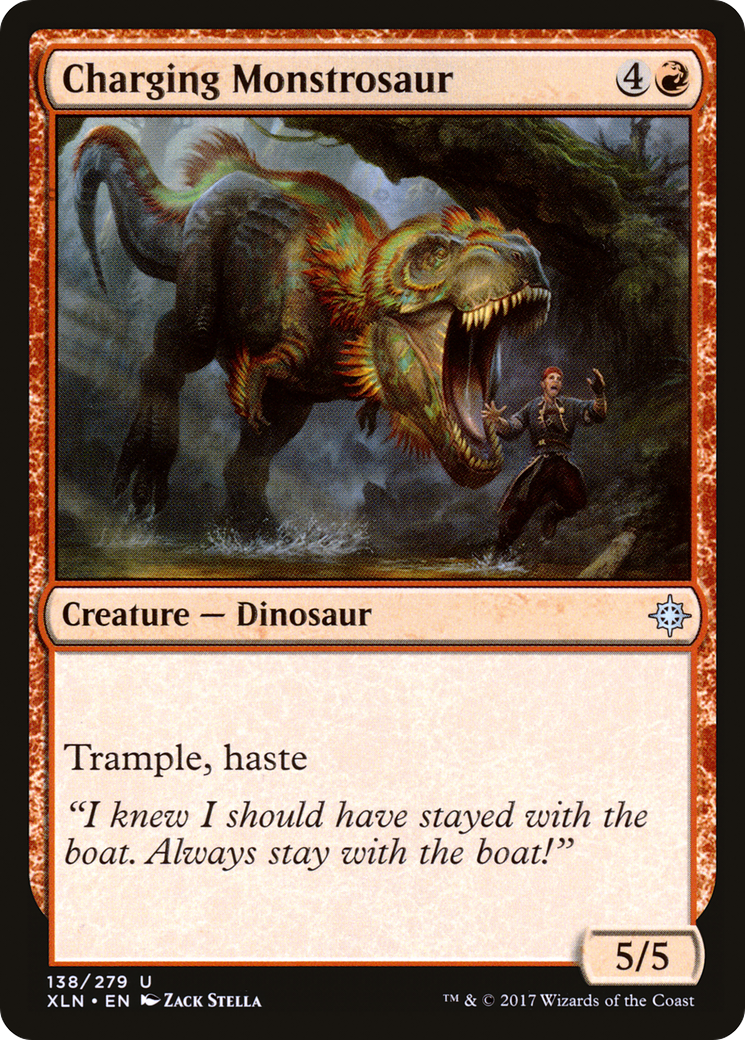
Bear with me, but what if we replaced Charging Monstrosaur with a 70% GIH winrate limited bomb like Bonehoard Dracosaur? In this thought experiment, let’s explore what bombs and power outliers do for a format.
Described as a Masters-set power level cube that wants to be approachable to new players and emphasize synergy and value,
Regular Cube is not lacking in efficient removal or interaction.
Each color in the Regular Cube has between zero and four 5 mana value creatures, because the format is lean enough where decks only have room for a few top-end creatures. Though the removal suite could be adjusted slightly to kill a 5/5 more often, Bonehoard Dracosaur has a number of things going for it from a designer perspective.
Most importantly, it’s a big red mythic bomb that can get both Timmy and Spikes excited because it’s close to the top of the cube’s power band. Secondly, while it’s powerful, Dracosaur is still a ‘Baneslayer’ and can be removed cleanly. Players have to decide if they can invest their mana into this bomb or wait for later when their opponent’s removal is spent. Because it doesn’t have haste or remove a creature immediately, it doesn’t speed up the game unnecessarily and disrupt the focus on synergy in the environment.
Now let me answer some of the main concerns with a card like Dracosaur.
It rewards players without having any synergy requirement. This is the main argument against Dracosaur: it’s possible in games that you untap with it, the whole game revolves around Dracosaur in a way that detracts from the cube’s synergy focus.
But an opponent facing down a Dracosaur has many possible options. It is very weak to removal, and if players can’t remove it efficiently, they can go wide or make it otherwise unprofitable for the Dracosaur to attack. For synergy focused decks, the card advantage of a Dracosaur that lived a turn or two is likely not insurmountable.
I would even go as far to say that raw power cards are necessary to make synergy feel rewarding. Pestermite and Firefist Striker can beat a Charging Monstrosaur and they certainly have what it takes to take down a Dracosaur as well.
In the long run, players who are able to consistently take advantage of synergy and play smart are still going to have an advantage.
It feels bad when Dracosaur snowballs the game. This is the truth of being a five mana creature in 2024. In order for a five drop to be relevant, it needs to be able to significantly alter the course of a game. This goes back to one of the hidden rules of Magic’s mana system. As mana values increase, the marginal ease of casting increases. In an average game of Magic, casting ones and twos is a lot easier than the jump from between casting a three-drop to a four-drop. By the time you get up to five, six, and seven mana, the card must tactfully scale in power without being too overbearing.
Dracosaur’s upkeep trigger can also look tame when compared to similarly costed creatures. Glorybringer, for example, is actively antithetical to the goals of the Regular Cube. It ends games quickly and removes key synergy pieces as a boring but strong play on most boards. Terror of the Peaks is another example of a five drop that ends games too quickly if unanswered.
On the other hand, plenty of fives drops might be too weak (like Magmaw), too generically good / slow the game down (like Siege-Gang Commander), or synergistic but oscillate between too good or not good enough (like Wrathful Raptors, Screamer Killer).
It might feel weird when you compare Dracosaur to a card like Mayhem Patrol, but on the other hand, the Regular Cube contains premium answers like Boneshards, Exclude, Repulse, and Oust. The environment offers lots of places for players to express their skill – a well-timed, Shelter, Giant Growth, or Ulcerate for example can easily blow out a Dracosaur. So I firmly believe Bonehoard Dracosaur has exactly the sweet spot of extra text that a five mana creature would need to stay relevant in a cube at the power level of the Regular Cube.
But the card is so swingy, it feels bad when it’s unanswered. I didn’t have the right removal in hand, my creatures were all slightly too small, and I couldn’t beat the barrage of 3/1s and card advantage the Dracosaur provided.
And I think this is also a plausible answer. If players can’t find the lines to beat the bomb often enough, or if the cards just don’t realistically line up how I’m describing, its raw power would be a bad fit. I think in that case we can safely call Dracosaur a bad bomb for the Regular Cube.
A Certain Kind of Swingy
For cubes designed for new players, bombs that are appealing to newcomers help a lot. These could be the Timmy cards that have clues like Mythic rarity symbols and big stat lines.
For example, Fable of the Mirror-Breaker is not the type of power outlier I envision for synergy focused, wider power band cubes. Enfranchised players wouldn’t dare pass it while new players may glaze over all the text. The card introduces a lot of decisions, likely best utilized by a Spike, and reduces variance by being resistant to removal.
When deciding what kind of power outliers are appropriate I think gut check works, but also you can ask yourself these questions…
- To what extent does this card invalidate the game before it? (Hornet Queen, Toxrill, Farewell)
2. To what extent is this card uninteractive but also game-winning? (Life from the Loam, Avabruck Caretaker, Krark-Clan Ironworks)- Does this card snowball uncontrollably too early for my environment? (Ragavan, Pack Rat, Citadel Siege)
- Does this card have both a high-floor AND high ceiling? (Fable, Thoughtseize, Counterspell)
Why Shuffle Up?
While Dracosaur is individually strong when compared to cards in the Regular Cube, I don’t think it’d invalidate the synergistic nature of the environment, given the strength of removal. Will it be powerful? Most likely. Will it be unfun? My theory is that its inclusion will help address the ‘overdevelopment’ trend I see in cube design.
To conclude the Regular Cube thought experiment, I think it would be interesting to see what the draft experience would be like if a number of something like 8-15 bombs were included in my version, taking up about 1-3% of the cube’s slots.
Ultimately, what are the benefits of having a few Dracosaur-level bombs to widen the power band?
-
Helps lower decision fatigue by giving drafters new to the environment a helpful first pick.
-
*Adds complexity to the draft by providing drafters a reason to pivot in later packs.* If players saw Judith or Falkenrath Aristocrat during pack 2 they just might say, “Oh I’m not Aristocrats so I’ll stay the course.”
-
Creates excitement because variance in power level is what makes Magic classically exciting. I think the importance of this point is not to be glossed over. All players, Spikes included, can feel good playing with and against bombs.
If bombs only exist in narrow power band cubes, then likely Dracosaur’s main cube home would be a cube full of haymakers like the Arena cube.
![][image2]
[image of Syndrome from Incredibles captioned “…and when EVERYONE’S super”]
no one is.
Bombs create fun. In addition to inciting the feeling of, “Yay, I opened a great card! How can I navigate this draft to use it properly?” variance in card power encourages players to feel skillful and clever when overcoming their opponents’ bombs. If all cards are flat in power level, then why are we shuffling them up at all?
We Need More Intimate Format Knowledge
But more than fun, the higher-variance cubes should be appreciated for the skill expression they allow as well. To use the MTGO Vintage Cube as an example, there’s a lot of play, but it might be locked behind extreme format experience. One skill unique to Vintage Cube, especially with in-pod play, is being able to anticipate and guess your opponents possible next plays from a limited but mechanically unique set of cards.
As an example, I want to illustrate how despite high variance, the games can also be quite small, with very big decisions. There isn’t always a line to win, but identifying the correct line when managing variance is fun and interesting. To set the scene, my opponent has zero cards in hand and in my deck I have Deathrite Shaman, Delighted Halfling in the deck. My opponent mulls to five and powers out T2 Minsc and Boo, sniping my Noble Hierarch with the first Hamster.
![][image3]
In this position, I lose if any of any of the following is true.
- They remove my follow-up creature
- They play a blocker and attack with Boo.
- They don’t attack with Boo.
So to win, I need to induce my opponent’s attack by playing a 1 power creature and use sneaky exalted. Meaning playing from this position, playing out Qasali Pridemage will lose me the game.
![][image4]
In the end, with luck on my side, they happened to find a creature, but one that I was able to remove with exalted on the stack.I think the beauty of this situation is that it’s very difficult to say who got luckier.
Is my opponent lucky for getting T2 Minsc and Boo on a mull to five? Or did they skillfully mulligan correctly? Did they make a mistake by sniping my Hierarch?
Or am I the lucker dog by having the only card in the game that would let me make this exalted-sac play? While my correct line wasn’t particularly next-level, at least I didn’t punt the game away by playing out Qasali Pridemage. Part of this example relies on my intuition and experience playing with and against Minsc and Boo.
![][image5]
In the end, my opponent concedes under time pressure after a Timetwister and stalled board.
I think Spikes do love getting this kind of in-depth format knowledge in their respective cubes. To be clear, I have no problems sitting down and drafting a narrow power band cube. I found Bun Magic at CubeCon, and similar cubes since, to be very fun and skill testing.
While many people like the Bun Magic experience for the tag line, “small games and big decisions,” I think the real innovation of a narrow power band cube is to mitigate the importance of specific format knowledge.
For Spikes on vacation, they can find a cube meet-up in a new city and draft a Bun Magic or Regular Cube with no fear. And for cube groups that often entertain newcomers, a flat power level might give the new members the most enjoyable experience against veterans of that cube. Because newcomers won’t be primed to exploit the intimacies of a format, flat power bands allow players to isolate and compare player skill. So while narrow power bands are currently associated generally with “Spikiness,” I think flat power bands should be more closely associated with “accessibility for Spikes.”
Because in a format for your weekly playgroup of Spike, Tammys, and Vorthos, a wider power band has a lot of accessibility benefits as well. After all, we’re playing Magic, not Chess. In a format with as much skill expression as cube, I think a lot of cubes could benefit from taking a few risks with their card choices with little detriment to the Spike experience.
The reality is that it’s hard to have a format as widely drafted as the MTGO Vintage Cube. While I have hundreds of drafts online, I have less than ten drafts of my own cube. And with more and more cubes being made, how can we foster the cubes that might require more intimate knowledge to be enjoyable?
Instead of designing cubes via whack-a-mole, are we able to think through the practices behind presenting a format that requires deeper format knowledge? These ideas will be explored more in Part 3.